Where Were You? How AI and Human Instinct Built Wereabouts at Pointless Palooza 2026


Dan Allen, Senior Client Strategist,
Maria Taborda, Senior Product Manager, and
Matt Sontag, JavaScript Developer
Article Categories:
Posted on
We had 12 hours, a werewolf mascot, and a wild idea. AI helped us move fast. Humans kept us from getting lost.
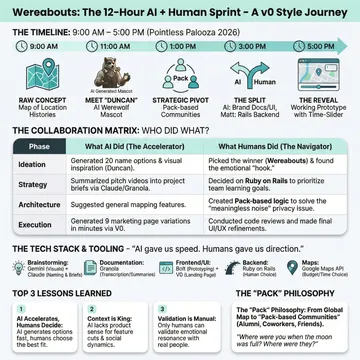
It was 9AM on the first day of Pointless Palooza 2026. A product manager, a client strategist, and a JavaScript developer had a raw concept and 12 hours blocked out to create something usable. Think of a reality competition cooking show, but for an app.
By 5PM, we had a working prototype for our core concept: a map showing where people have lived over time, with a slider that lets you drag through the years and watch locations appear and disappear. When two people were in the same place at the same time, you'd see it. The ultimate goal was to identify these overlaps quickly, spark connections, and inspire conversations.
This was Matt's and my first Palooza. Maria had participated before, but this was the first year where AI played such a big role. This is the story of building Wereabouts. The decisions we made, the problems we hit, and what we learned about the balance between AI assistance and human judgment.
AI as Creative Partner for Ideation

The concept creator, Matt (our JavaScript developer), has always had a unique affinity for werewolves. He used Gemini’s Nano Banana to generate visual inspiration with the prompt: "friendly werewolf holding a pocket watch." The result was a funny image of a werewolf holding a watch that we dubbed Duncan. Something about Duncan sparked the werewolf theme: hidden identities, transformation, finding your pack.
I ran Matt's 90-second pitch video through Granola to create a summary, then fed it to Claude to generate a brainstorming document and project brief.
From there, I used this prompt to generate name options:
<task>
Generate 20 creative, memorable, and marketable app names for my new product.
</task>

<description>
[Interactive timeline map that visualizes location histories and reveals serendipitous overlaps]
</description>

<keywords>
[serendipity, connections, timeline, travel, mapping, shared experiences, location history]
</keywords>

<target_audience>
[Frequent travelers, remote workers, expats, socially connected professionals]
</target_audience>

<brand_vibe>
[Minimalist, Friendly, Playful]
</brand_vibe>
After reviewing the options, we landed on Wereabouts which was a slight modification of "whereabouts" that we refined ourselves. The wordplay was perfect: "whereabouts" (location) + "were" (past tense) + "werewolf" (hidden reveal). Ironically, it was very close to "Werewhen," an internal name Matt had already come up with on his own from the start.
AI (Nano Banana again) also helped us quickly generate logo ideas. We landed on a map pin with wolf ears.

Human Judgment: The Critical Decisions
While AI accelerated our creative process, every strategic decision required human judgment:
Tech Stack - Learning Over Speed: Pointless Palooza is dedicated time to experiment. Matt wanted to learn Ruby on Rails, so we chose Rails over faster alternatives. Prioritizing learning goals over efficiency isn't a call AI can make.
Maps - Google vs. Mapbox: We debated costs, customization, and brand fit. With 12 hours and a limited budget, we chose Google Maps over the more customizable (but more expensive) Mapbox. This required industry knowledge, budget constraints, and timeline assessment.
Community - Based Architecture: This was our biggest insight, and it was entirely human-driven. We realized that if everyone can see everyone's location history, it's just meaningless noise. Who cares if a random stranger was in Houston in 2015?
The solution: pack-based communities. You join specific groups (e.g., your company, alumni network, soccer league, etc…) and see overlaps within those communities. This required understanding human behavior, social dynamics, and the privacy/value tradeoff. These are judgment calls rooted in experience, not something AI could have navigated.
AI as an Extension of the Team for Execution
In the afternoon, we divided the remaining tasks and used AI to accelerate the work. While Maria built an early prototype in Bolt and explored color palettes, I used Claude to develop brand guidelines by feeding it Granola notes from our morning stand up and curated brand prompts. Matt built the Rails backend, leaning on AI only for autocomplete and to speed up some of the code writing, since the goal was to learn the framework himself.
When we met later that afternoon, we had:
- Completed branding guidelines
- An interactive prototype in Bolt
- The app live on AWS
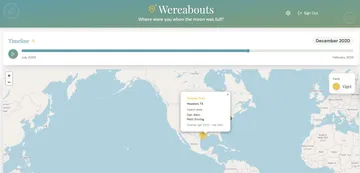
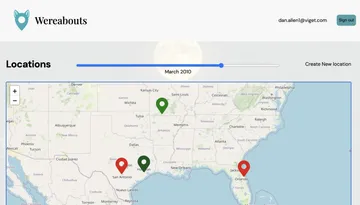
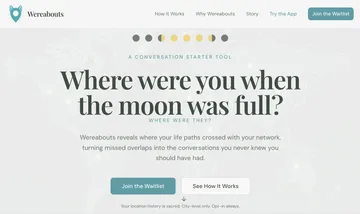
For six hours of work, this was remarkable. That evening, I created a marketing page from scratch using V0. It took nine iterations to get right.
What We Learned About AI + Human Collaboration
The through-line of this whole project: AI generates options rapidly; humans make the calls that matter.
AI gave us speed on names, brand voice, marketing page variations, and visual prototypes. Humans made the strategic calls on the architecture, the feature cuts, the emotional resonance. The magic wasn't in either alone. It was in the combination.
Using Granola + Claude, we went from pitch video → summary → brainstorm doc → project brief → 20 name options → brand guidelines in under two hours. Without AI, that takes days. But without human judgment, the output is generic and misses the nuance that makes something worth building.
Time constraints forced useful clarity: some things AI could handle, and some things we had to decide ourselves. Speed reveals what matters.
What AI still can't do is validate whether people will care. We built faster, but we still need to find out if the concept resonates.
The Result
We're going to keep working on Wereabouts. Because in 1.5 days, we proved:
- The concept resonates (people care about discovering shared history)
- It's technically feasible (we built a working prototype)
- The AI + human workflow works (it genuinely accelerates ideas)
Where were you when the moon was full? Where were they?
We built the tool to find out. The point of Pointless Palooza isn't just to build something fun. It's to experiment with new workflows, tools, and ways of working. AI is an incredibly powerful creative partner when guided by human judgment, experience, and heart.
Closing Thoughts from the Team
Dan
The knowledge sharing across teams was one of the highlights I really loved, from early ideation and kickoff through to the presentations and retrospectives. I came away feeling like I'd done an intensive "PhD" crash course in Claude, and I'm now going deeper with Claude Code via Terminal, building out custom Skills and learning more about Plan Mode and MCP. Beyond this, I'm embracing GitHub and Docker and how I can use those tools as I learn more about implementing AI into my own workflow.
Maria
My favorite thing about Pointless this year was how dramatically the bar for what's possible in a short amount of time shifted. I felt empowered to tackle things normally outside my skill set, like building a fully functional prototype. With AI moving so fast it's easy to feel behind, but a few hours of experimenting can really move the needle on your confidence. More than anything though, what stood out most was how much the human element still mattered. Connection is ultimately what made this such a great experience for all of us.
Matt
My most valuable takeaway is how helpful AI proved as both an ideation engine and as a communication tool. AI allowed us to really lean into the idea that it is easier to modify what is written than to write from scratch. Separately, if a picture is worth a thousand words, an interactive prototype is worth hundreds of pictures. AI creating fully realized, working demos streamlined our communication and encouraged active collaboration before sunk costs trapped us - psychologically if not literally - in a single approach.


