Pointless Lessons: How We Built Scooter Commuter

Bre Corn, Business Operations Associate,
Jackie Yu, Senior Product Designer,
Abby Smith, Product Designer,
Sadie Finn, Project Manager, and
Claire Atwell Eisinger, Product Management Director
Article Categories:
Posted on
Scooter Commuter is a game that makes the invisible commute visible again. It helps remote workers mentally “arrive” at work while creating space for boundaries and wellness.
Remote work removed the need for a commute and allowed people to clock-in from anywhere, but it also blurred the boundaries between work and home life. For employees craving a separation, Abby Smith’s idea of Scooter Commuter is the answer.
Abby pitched the idea of creating a ritual that makes the invisible commute visible by simulating the feeling of waking up, taking a yoga class, getting ready, grabbing a coffee, and commuting to the office while never leaving your house. Claire Atwell Eisinger, Jackie Yu, Sadie Finn, and Bre Corn joined the team and helped make the game come to life in 48 hours for our annual hackathon, Pointless Palooza. In this short time we went from idea to innovation as we explored new skills and tested new tools.
Scooter Commuter is a lightweight game played in the browser and designed to help remote workers mentally transition into their workday. Players move through a series of small, playful moments which creates the mood for intention, boundaries, and a healthier start to the day.
Game Inspiration
Before building, we tested some popular, nostalgic, and niche games to see what game style and elements we wanted to incorporate in Scooter Commuter.
We discussed core elements that make these games exciting for us to play and that we wanted to nail in our own project. These were our top 10:
- Clear and simple rules
- Meaningful user choices
- A reasonable challenge curve
- Consistent feedback loops
- Intrinsic motivation
- Accessibility
- Curiosity gaps
- Social connection &
competition - Visual clarity
- Reactive controls
Brainstorming
After nailing down our inspiration and requirements, we got to work on visualizing our ideas. We created shared Notion and Whimsical workspaces to individually think through our ideas before collectively deciding on a direction.
Sadie leveled up our conceptual Viget inspired commute by suggesting we help players jump start their day by using the game to prompt players in real life. They are encouraged to grab snacks, do sun salutations, hydrate, get dressed, and turn on their favorite playlist.
Creating
With a solid idea, guidelines, and benchmarks, we got started bringing this idea to life. We created a version plan of the game that would lead to the best results before the deadline.
Abby completed the heavy lift of developing the entire game. She took a crash course on Phaser, handled repository setup, and refactored a 1000-line code base to help our vision come to life. Claire took on the work of not only containing this project but literally containing the game by converting the wall system from rectangles to individual tiles, using Copilot.
Their work resulted in a final tech stack of: JS / React, Phaser.js, and Vercel.
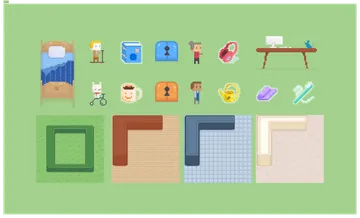
Sadie, Bre and Jackie handled game design, pixel visual elements, documentation, and concept definition. We collaborated in Figma and Notion to asynchronously coordinate on the activity prompts, room design, character aesthetics, and splash screens that helped bring the game to life.
The 48-hour hackathon was a huge success. Palooza culminates in a company-wide work showcase, and we're proud to say the idea resonated with many of our peers.
The Scooter Commuter build doesn't stop here. The team has plans to add a more complex map, additional playable characters, and maybe even a leaderboard to track your daily score. Go check out Scooter Commuter before you start your next work day and read some takeaways from the team!

Takeaways
Abby: Don't let your AI work in one file. Force it to do file structuring based on functionality as it works ... or else face the consequences.
Bre: Constraints push the limits, breed creativity, and force me to be realistic about what I can and learn in 48 hours. With a great team supporting you, it can be a lot!
Claire: It’s fun to solve hard problems with smart people.
Jackie: Figma has its limits. I have never approached them before, but it can do a lot more than I thought, especially in the visual graphic space compared to the UI space that I usually work in.
Sadie: Share your ideas, even if you think they're bad! I almost deleted my idea because it was a different direction than we had initially talked about, but it ended up resonating the team and we transformed it to make something super cool!


